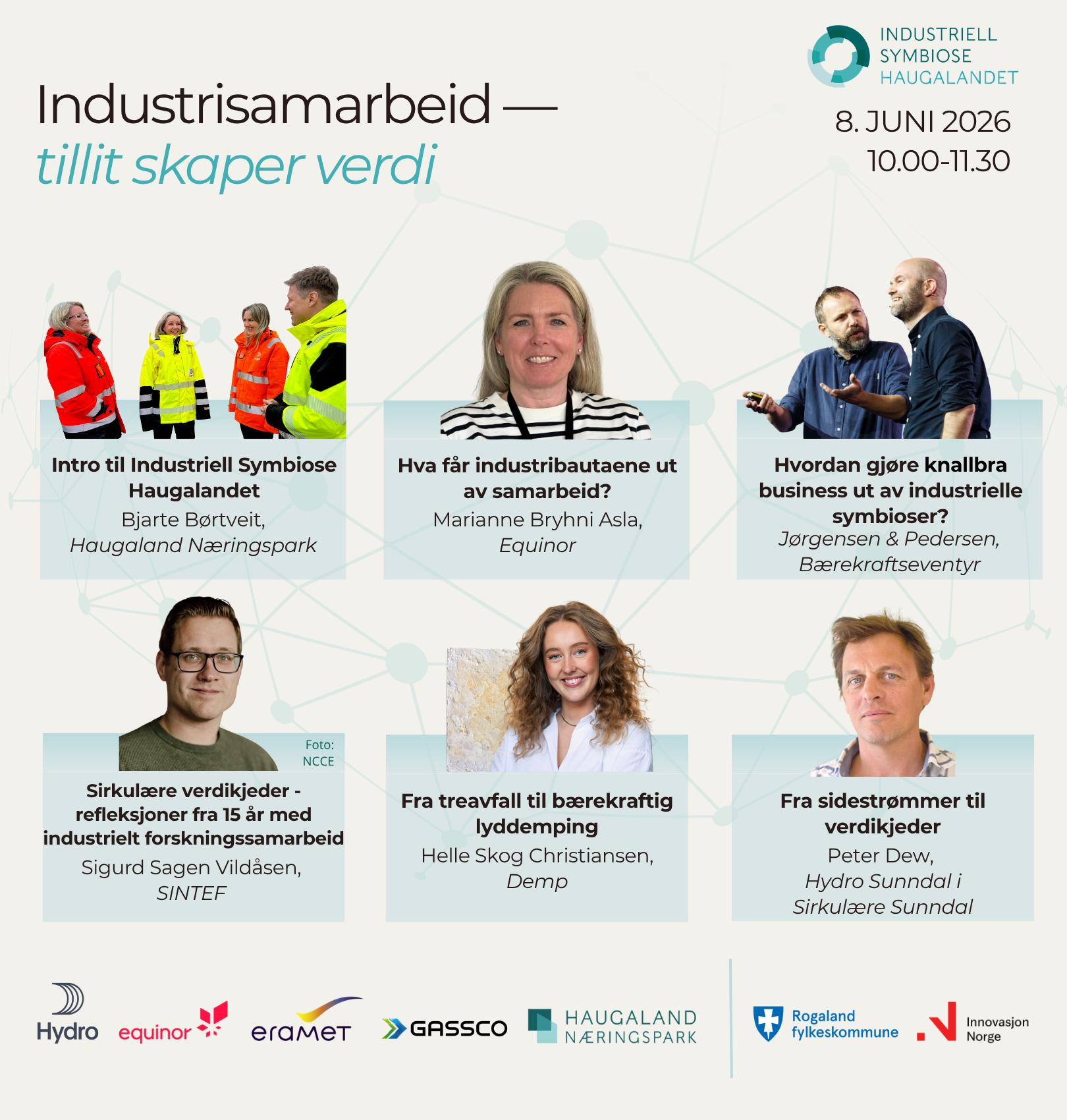
Public actors, industry and business gathered for a webinar on Monday, June 8, to explore how industrial collaboration creates new value, and why trust is the most important input factor.
The webinar "Industrial cooperation - trust creates value", organized by Industriell Symbiose Haugalandet, brought together a broad panel of industry, research and business. The project is funded by Rogaland County Council and Innovation Norway, and aims to highlight and further develop the opportunities for industrial symbiosis in the region.
– Here at Haugalandet, we are used to developing ourselves and seeing opportunities. And that is precisely what we must continue to do, said Bjarte Børtveit, project manager at Industriell Symbiose Haugalandet, in his opening of the webinar.
Relationships open doors
Public actors, industry and business gathered for a webinar on Monday, June 8, to explore how industrial collaboration creates new value, and why trust is the most important input factor.
The webinar "Industrial cooperation - trust creates value", organized by Industriell Symbiose Haugalandet, brought together a broad panel of industry, research and business. The project is funded by Rogaland County Council and Innovation Norway, and aims to highlight and further develop the opportunities for industrial symbiosis in the region.
– Here at Haugalandet, we are used to developing ourselves and seeing opportunities. And that is precisely what we must continue to do, said Bjarte Børtveit, project manager at Industriell Symbiose Haugalandet, in his opening of the webinar.
Relationships open doors
Marianne Bryhni Asla from Equinor pointed out how the industry is changing, with increasing expectations from authorities and society. For Equinor, participation in Industrial Symbiosis Haugalandet has been valuable, and Asla particularly highlighted that the players now know each other well enough to see the opportunities also outside the traditional symbioses.
– Eramet, Hydro and Equinor are large international companies with professional networks across locations. Individual environments at one location can therefore be very small. Then being able to draw on each other is invaluable, she said.
Sveinung Jørgensen and Lars Jacob Tynes Pedersen from the NHH Centre for Responsible and Sustainable Business, and podcast hosts for Bærekraftseventyr – most recently with Bjarte Børtveit and Hilde Sandvold Røsand as guests – presented how to build profitable business models around industrial symbioses.
– When are you willing to take risks to potentially create value together? The point of trust is precisely this: that you dare to enter into uncertainty because you trust your partners, they summarized.
Sigurd Sagen Vildåsen from SINTEF shared experiences from 15 years of industrial research collaboration. Vildåsen highlighted the importance of the question “What values are we missing in the network around us?” Some of the greatest values arise precisely through open and seemingly abstract discussions.
From waste to value chain
Helle Skog from Demp presented a living example of industrial symbiosis in practice. The company produces sustainable sound panels from mycelium (fungal root network) and Norwegian wood waste.
She emphasized that the greatest value often lies between the companies. The wood waste, the research on mycelium, and the market for sound panels all existed before. It was the collaboration that brought them together.
Peter Dew from Hydro Sunndal showed how Hydro's plant in Sunndal is working systematically to turn side streams into value chains through the Circular Sunndal project. Hydro has ambitious goals for circularity, where collaboration with local businesses and authorities is central to the strategy to achieve the goals.
Haugalandet shows the way
The overarching message from the webinar was clear: industrial symbiosis is not primarily about technology, but about relationships, trust, and the willingness to try. The balance between trust and risk was a theme that all speakers returned to.
– It has been both inspiring and educational to hear about other people's experiences, and not least to see ourselves through the eyes of others, concluded Bjarte Børtveit.